Before going on with today's blog, I would like to conduct some business. First, a retraction. Last night I was very tired and beside several major typos, I got the name of the hospital wrong. It is "Greytown'" not "Greyswtone." Also, it has been hard to send the notification emails from here. They do not seem to go through. Please checkfor the blogs each weekday, and I will try not to disappoint.
Today began early for Jamil and me. We attended the Greys Hospital version of our mortality conference, where they discuss deaths on the service and how they might be avoided in the future, without laying blame. In Kwazulunatal they take our version further in that they not only look for mistakes within the hospital and doctors, but, also, within the system. This is so important here, as they can determine where best to apply their limited resources to avoid deaths.
We then headed to Northdale Hospital, the former Indian Hospital under apartheid. This is classified as a community hospital which implies that there are no certified pediatricians or other specialists. This does not prevent huge numbers of patients from showing up in the outpatient department. There is a significant emphasis on "kangaroo" care for small birth weight neonates. This involves comfort and support for the mothers of premature babies to have the babies supported against their chests for feeding, comfort and control of body temperature. This conserves resources and nursing in these high risk children.
We then moved back to Greys, where we rounded with th echief of service for 2 1/2 hours. It has been a long time since I did this, and it is hard on the legs and backs. The cases were by and large very ill and quite interesting. The recurrent theme of HIV/Aids, TB, and malnutrition was very evident. Here, there was much brain involvement and other severe consequences. Most sobering was that there were several children who did not satisfy the criteria for admission to the ICU because there chance of survival was minimal, and there were limited spots in the ICU.Dadah, who was brilliant by any international standard. He discussed his choice of going into the public sector and passing up the riches of the private sector. He was inspiring, and we are all fortunate that there are people like him.
Hennie and Bill continued their work and even had a solid lead. Each day brings some good hope and we wish for that one break.
Larissa spent a successful day at Edendale Hospital working on the pediatric wards with the children and mothers. She got to interview some mothers and got to work on a photography project in which she had children use photography to express some of their feelings about themselves and their condition.
Another successful and inspiring day.
Marty
Wednesday, February 16, 2011

Tuesday, February 15, 2011
Greyswtone Hospitaql
Today Jamil, Larissa and I along with an attending went to visit Greystone Hospital, a satellite of the Pietermaritzburg hospitals serving a more rural community. The hospital is staffed by 12 physicians doing community service. These are generalists w3ho have had 2 years of internin g following medical school who are required to put in a third year, usually in more remote areas. There was a young man who was very sharp and who covers the entire pediatric service alone for 6 months before moving on to another specialty. There are about 60 pediatric beds, and his only support is a once a month visit by an attending. Otherwise he has to rely on telephone advice. Night coverage is by 2 physicians for the entire hospital which includes all specialties, emergencies, anesthesia, c-sections and surgery. Again the concept that if you do not do it, nothing gets done.
The physical plant was very nice and the nurses seemed the best we have encountered. It is very apparent to me that one has to stop and think that the patient population is so much sicker than what we are used to at home. Already, we take it for granted. The three big entities of HIV/AIDS, TB, and malnutrition are all pervasive. There was a ward just dedicated to malnutrition far beyond anything seen in the US with the addendum that many of the children on the other wards also had malnutrition accompanying other illnesses. The mothers sitting at the bedsides are frequently sicker than their kids and the social conditions are daqunting. We saw a baby who was very ill, probably secondary to some traditional medicine by a local healer. One has to bite their tongue and realize that one has to work in coordination with these healers because they have the confidence of the people. A typical African balancing act.
Larissa has been working with occupational therapists and seems to have hit her stride. We travelled with 2 young psychologists who were visiting a mental hospital near Greystone. I had a long informative discussion with them that touched on many subjects. How does one separate mental illness from cultural behavior when one is not part of that culture? How does a white woman win the confidence of Zulu men to facilitate treatment? How does one diagnose depression in a community devastated by death, disease, and starvation? The answers are difficult and I will share my limited understanding when I return. The young psychologists also brought up other interesting issues. One of them was very light skinned colored (mixed race). Under the present system in 2011 South Africa, affirmative action is practiced enthusiastically. She applied for school referencing her black origins and was told that she was not black enough. Under apartheid she was not white enough. In school, the professors were told that all blacks must pass, so it left all the competition between the whites and mixed races.
Bill and Hennie continue to work on making Thokomali Nathi a viable entity. They are now at the vicious cycle where they need a full time director to create enough viability to pursue fundraising. To finance the project they need about $30,000 US to pay the salary of the director. If anyone has an extra $30,000 or a sugar daddy in South Africa please let us know. In the absence of that, we push on beating the bushes (bad expression here).
Marty
The physical plant was very nice and the nurses seemed the best we have encountered. It is very apparent to me that one has to stop and think that the patient population is so much sicker than what we are used to at home. Already, we take it for granted. The three big entities of HIV/AIDS, TB, and malnutrition are all pervasive. There was a ward just dedicated to malnutrition far beyond anything seen in the US with the addendum that many of the children on the other wards also had malnutrition accompanying other illnesses. The mothers sitting at the bedsides are frequently sicker than their kids and the social conditions are daqunting. We saw a baby who was very ill, probably secondary to some traditional medicine by a local healer. One has to bite their tongue and realize that one has to work in coordination with these healers because they have the confidence of the people. A typical African balancing act.
Larissa has been working with occupational therapists and seems to have hit her stride. We travelled with 2 young psychologists who were visiting a mental hospital near Greystone. I had a long informative discussion with them that touched on many subjects. How does one separate mental illness from cultural behavior when one is not part of that culture? How does a white woman win the confidence of Zulu men to facilitate treatment? How does one diagnose depression in a community devastated by death, disease, and starvation? The answers are difficult and I will share my limited understanding when I return. The young psychologists also brought up other interesting issues. One of them was very light skinned colored (mixed race). Under the present system in 2011 South Africa, affirmative action is practiced enthusiastically. She applied for school referencing her black origins and was told that she was not black enough. Under apartheid she was not white enough. In school, the professors were told that all blacks must pass, so it left all the competition between the whites and mixed races.
Bill and Hennie continue to work on making Thokomali Nathi a viable entity. They are now at the vicious cycle where they need a full time director to create enough viability to pursue fundraising. To finance the project they need about $30,000 US to pay the salary of the director. If anyone has an extra $30,000 or a sugar daddy in South Africa please let us know. In the absence of that, we push on beating the bushes (bad expression here).
Marty
Monday, February 14, 2011
Greys Hospital
Today was a most satisfying and encouraging day for the team. We spent the day at Greys Hospital, the former all white hospital ynder apartheid. Bill Met with Neil McKerrow early in the day to gauge Neil's actuasl commitment to the mother lodges. Neil gave an enthusiastic go ahead and Bill seemed energized. There is still the long hard task of fundraising and hiring a local person to run the operation, but at least we have a positive direction.
Larissa was put in the company of occupational therapists at the hospital with whom she related well. She was able to spend the day with them and interact with the children. The occupational therapists seemed quite enthusiastic about the programs that Larissa brought to the table and this was gratifying. This seems like the proper avenue for Larissa to make a difference.
Jamil and I were given an introduction to the hospital as well as a better understanding of the strenghts and weaknesses of the healthcare system by the head of pediatrics. We spent some time in their emergency room and then experienced their pediatric cardiology clinic. Since Greys is a referral hospital, the wards are full of fascinating cases, and pathologies rarely seen in the US.
We all had a meeting with Neil McKerrow who better clarified our objectives and the definition of success in our mission. I think that we all left the meeting with a better feeling of the possibility of accomplishment, even on our short journey. The short of it is that we are a stepping stone in hopefully a long relationship that will have a significant impact. I believe that we are all content with this.
Tonight, too, was very special. Hennie has begun an all black Rotary club in Pietermaritzburg. It is the Rotary Club of Ugungundlovu. We all attended a meeting this evening. The club follows all of the principles of Rotary, but incorporates some of the Zulu culture to make it feel comfortable. It meets with a simple supper prepared by one of the members. Since cost is a major object, things are run tightly. There is an interesting variety of members inclucing pastors, nurses, a social worker, a farmer, and 2 men who work with refugees from other African countries. We all got to address them, and the gratitude expressed vocally and on their faces was heart warming and made me proud to be a Rotarian. This club should become a well earned legacy to Hennie and what he stands for.
The contrast between Greys and Edendale Hospitals is remarkable and is part of the problem of the healthcare system in its inconsistency. Tomorrow we travel to Greytown Hospital, a more rural Hospital.
Marty
Larissa was put in the company of occupational therapists at the hospital with whom she related well. She was able to spend the day with them and interact with the children. The occupational therapists seemed quite enthusiastic about the programs that Larissa brought to the table and this was gratifying. This seems like the proper avenue for Larissa to make a difference.
Jamil and I were given an introduction to the hospital as well as a better understanding of the strenghts and weaknesses of the healthcare system by the head of pediatrics. We spent some time in their emergency room and then experienced their pediatric cardiology clinic. Since Greys is a referral hospital, the wards are full of fascinating cases, and pathologies rarely seen in the US.
We all had a meeting with Neil McKerrow who better clarified our objectives and the definition of success in our mission. I think that we all left the meeting with a better feeling of the possibility of accomplishment, even on our short journey. The short of it is that we are a stepping stone in hopefully a long relationship that will have a significant impact. I believe that we are all content with this.
Tonight, too, was very special. Hennie has begun an all black Rotary club in Pietermaritzburg. It is the Rotary Club of Ugungundlovu. We all attended a meeting this evening. The club follows all of the principles of Rotary, but incorporates some of the Zulu culture to make it feel comfortable. It meets with a simple supper prepared by one of the members. Since cost is a major object, things are run tightly. There is an interesting variety of members inclucing pastors, nurses, a social worker, a farmer, and 2 men who work with refugees from other African countries. We all got to address them, and the gratitude expressed vocally and on their faces was heart warming and made me proud to be a Rotarian. This club should become a well earned legacy to Hennie and what he stands for.
The contrast between Greys and Edendale Hospitals is remarkable and is part of the problem of the healthcare system in its inconsistency. Tomorrow we travel to Greytown Hospital, a more rural Hospital.
Marty
Saturday, February 12, 2011
The End of Our First Week
On Friday, Bill broke off from the group to meet with Yvonne Spain, a former elected official and one of the organizers of Thokomala Nahte, a fledgling NGO, which should be the backbone for much of Bill's work. Bill was also put in touch with Hennie's son, a partner with a very large law firm in Johannesburg. He will advise pertaining the legalstructure of what we are doing, as well as putting us in contact with significant aspects of the philanthropic community.
Larissa, Jamil and myself returned to Edendale to continue our observation and enhance our understanding of the healthcare system and the culture of both the patients and the doctors. I have noted that there is much more presence of fathers bringing children to the doctor than was present 4 years ago. This is encouraging. Jamil and I also were part of a case of a 3 year old hemophiliac whose twin has already died of the disease. The cost of his care is almost $1000 per week in a system where that sum is enormous.
I have noted a different attitude to patient death here that is probably a defense mechanism on the part of the physicians. At night, the emergency care of outpatient children is in the hands of a single first year resident with very little backup. This is superimposed on treating some of the sickest children anywhere. In questioning the young woman on call, she speaks of knowing that she is doing her best in an impossible situation and can deal with subsequent outcomes.
Friday night began the weekend well for Larissa and me. Larissa's host had to leave town and she is being hosted by an incredibly gracious nursing teacher, Kathy, who invited Larissa, Hennie, Beth and myself to the prenuptial ceremony of her niece. The purpose of the ceremony is for the women to bless the bride and to apply sandalwood paste to her face as part of the blessing. The room was decorated beautifully, and the women were dressed exquisitively. We were welcomed as if we were part of the family, and Beth and Larissa even took part in the ceremony. The food was very good. Saturday, Larissa will be going to the actual wedding. How is that for hospitality.
Daksha continues to improve slowly and our thoughts are always with her.
That is all for this week, hope you are all well.
Marty
Larissa, Jamil and myself returned to Edendale to continue our observation and enhance our understanding of the healthcare system and the culture of both the patients and the doctors. I have noted that there is much more presence of fathers bringing children to the doctor than was present 4 years ago. This is encouraging. Jamil and I also were part of a case of a 3 year old hemophiliac whose twin has already died of the disease. The cost of his care is almost $1000 per week in a system where that sum is enormous.
I have noted a different attitude to patient death here that is probably a defense mechanism on the part of the physicians. At night, the emergency care of outpatient children is in the hands of a single first year resident with very little backup. This is superimposed on treating some of the sickest children anywhere. In questioning the young woman on call, she speaks of knowing that she is doing her best in an impossible situation and can deal with subsequent outcomes.
Friday night began the weekend well for Larissa and me. Larissa's host had to leave town and she is being hosted by an incredibly gracious nursing teacher, Kathy, who invited Larissa, Hennie, Beth and myself to the prenuptial ceremony of her niece. The purpose of the ceremony is for the women to bless the bride and to apply sandalwood paste to her face as part of the blessing. The room was decorated beautifully, and the women were dressed exquisitively. We were welcomed as if we were part of the family, and Beth and Larissa even took part in the ceremony. The food was very good. Saturday, Larissa will be going to the actual wedding. How is that for hospitality.
Daksha continues to improve slowly and our thoughts are always with her.
That is all for this week, hope you are all well.
Marty
Thursday, February 10, 2011
Edendale Revisited
Last night we were hosted at a cocktail reception at Greys Hospital, presented by the board of the hospital. We were greeted by rotarians, board members, administration, staff members and nursing hierarchy. They were most gracious, and . treated us with great hospitality. Most importantly it afforded us each the opportunity to meet with people with whom we hope to accomplish our mission. In all, a pleasant and productive evening.
Today, Bill and Hennie got down to some solid planning in anticipation of Bill's meeting tomorrow with Yvonne, one of the organizers of the NGO with whom we intend to work and a key to the homes for the lodger mothers. The rest of us returned to Edendale Hospital. We all rounded in the neonatal ICU, where we witnessed a fine housestaff doing an excellent job under most difficult conditions with antiquated equipment, much of which was in need of repair.
Larissa then met with occupational therapists and is scheduled to begin working with them at the beginning of next week. She also was asked to demonstrate part of her program to nurses on the wards. The bulk of her day was spent with Matilda, a pediatric attending in charge of the sexual abuse unit, which is quite busy, and also in charge of the neurodevelopmental aspects of pediatrics at Edendale. she and Larissa spent much time together, and will continue to meet and try to develop a stimulation program.
Jamil and I spent the day in the pediatric outpatient clinic and ER. With were taken under the wing of Annu, an attending from England. He had arrived to begin his work on the day that I visited Edendale in April. He is a remarkable young man who has worked much in Africa. He has assimilated well into the south African culture and is kind, and compassionate to the Zulu population. On top of that he is a fine pediatrician, who has developed fine instincts to make up for the lack of support. All of the patients were quite ill, with the assumption of HIV and TB until proven otherwise. Through seeing the patients, we were exposed to many of the social issues involving the population
Daksha had her surgery today and is resting comfortably. We think of her and speak of her often, and hope for her swift recovery. We hope that she will soon be able to pursue her part of the project.
Marty
Today, Bill and Hennie got down to some solid planning in anticipation of Bill's meeting tomorrow with Yvonne, one of the organizers of the NGO with whom we intend to work and a key to the homes for the lodger mothers. The rest of us returned to Edendale Hospital. We all rounded in the neonatal ICU, where we witnessed a fine housestaff doing an excellent job under most difficult conditions with antiquated equipment, much of which was in need of repair.
Larissa then met with occupational therapists and is scheduled to begin working with them at the beginning of next week. She also was asked to demonstrate part of her program to nurses on the wards. The bulk of her day was spent with Matilda, a pediatric attending in charge of the sexual abuse unit, which is quite busy, and also in charge of the neurodevelopmental aspects of pediatrics at Edendale. she and Larissa spent much time together, and will continue to meet and try to develop a stimulation program.
Jamil and I spent the day in the pediatric outpatient clinic and ER. With were taken under the wing of Annu, an attending from England. He had arrived to begin his work on the day that I visited Edendale in April. He is a remarkable young man who has worked much in Africa. He has assimilated well into the south African culture and is kind, and compassionate to the Zulu population. On top of that he is a fine pediatrician, who has developed fine instincts to make up for the lack of support. All of the patients were quite ill, with the assumption of HIV and TB until proven otherwise. Through seeing the patients, we were exposed to many of the social issues involving the population
Daksha had her surgery today and is resting comfortably. We think of her and speak of her often, and hope for her swift recovery. We hope that she will soon be able to pursue her part of the project.
Marty
Wednesday, February 9, 2011
Thandanani
Today we got to see the circumstances under which the people in the surrounding areas lived. We were shown the area through Thandanani. This is an organization which through mostly volunteer help sends in community workers and health service workers to serve 2,000 orphaned and at risk children and then to oversee their care. The families are identified and then worked with over a 3-4 year period. The areas we travelled through was extremely poor, with inadequete housing, and dirt roads which were difficult to navigate. Still there was progress, as we visited a family I had seen in April, who were now in a new cinder block house. The progress is slow, but it is there. At that home we were able to give a 3 year old girl with no shoes a pair of shoes brought with me, and painted by the kids in Orange county.
We then got to visit a cemetery in the area, with an unbelievable number of fresh graves. The Zulu traditionally do much to create long, elaborate funerals. They feel that constant contact with the family, even after death is essential, and fear the consequences if they are neglectful. These funerals can use up much of their meager resources.
We then left to return to Thandanani where we met with Duncan, the director. Bill had spent the morning with Duncan discussing fundraising and the finer points of managing an NGO in South Africa. Duncan gave us much insight into interactions with the Zulu, and how their cultural beliefs became obstacles in trying to implement some of the programs. Their "live for today" attitude undermines any thought of projects such as microcredit. Duncan is an energetic person who travels all over the world for his funding. He has been at this NGO for many years and still maintains his enthusiasm.
Tonight we are being hosted at Greys Hospital by the Board.
Marty
We then got to visit a cemetery in the area, with an unbelievable number of fresh graves. The Zulu traditionally do much to create long, elaborate funerals. They feel that constant contact with the family, even after death is essential, and fear the consequences if they are neglectful. These funerals can use up much of their meager resources.
We then left to return to Thandanani where we met with Duncan, the director. Bill had spent the morning with Duncan discussing fundraising and the finer points of managing an NGO in South Africa. Duncan gave us much insight into interactions with the Zulu, and how their cultural beliefs became obstacles in trying to implement some of the programs. Their "live for today" attitude undermines any thought of projects such as microcredit. Duncan is an energetic person who travels all over the world for his funding. He has been at this NGO for many years and still maintains his enthusiasm.
Tonight we are being hosted at Greys Hospital by the Board.
Marty
Tuesday, February 8, 2011
Edendale Hospital
We had another long day, but it was very satisfying and encouraging. We went to visit Edendale Hospital, the former all black hospital, which has had there top 4 floors condemned, but still in use. The corridors are dark and the hospital is very poorly equipped. Both the temperature and the humidity were in the 90's which added to the experience. We were met by Les Hall, the head of the pediatric department and a consultant, Amith, both of whom were very gracious and happy to have us. I believe that the fact that I have returned is out of the ordinary and they have treated us accordingly. We also spent some time with another consultant, Annu, from England and very energetic, who started working in Edendale on the day that I visited in April.
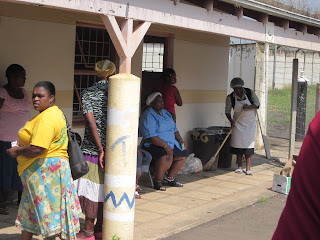 We first visited the lodger mothers' area for Bill to evaluate what he could do. The area was stark and crowded as pictured above, but Bill was encouraged by the fact that there was something and that the concept was in place. Again we were told that there was land to build and they were even amenable to its being owned outside the hospital authority. We spoke to a few mothers who were delighted by the prospect of improved facilities.
Bill and Hennie left to begin working on getting fundraising going. Jamil, Larissa, and I then went on long pediatric rounds with Amith. The quality of the medical staff was good, but there was a complete disconnect with the nurses who did not seem to be doing very much. It was almost as if the relationship between doctors and nurses was adversarial. The patient population was pretty ill with HIV and TB being a frequently used diagnosis. The wards were ill equipped and stark. We then went o withess a play and stimulation area in keeping with Larissa's work. It is open for 1-11/2 hours five days or less per week and staffed by a volunteer who is spread between 15 or more kids. We helped out for this period and will try to connect Larissa with occupational therapy to try to institute programs.
In all, a day with much encouragement for our project, but up close reality of the situations.
Marty

Bill and Hennie left to begin working on getting fundraising going. Jamil, Larissa, and I then went on long pediatric rounds with Amith. The quality of the medical staff was good, but there was a complete disconnect with the nurses who did not seem to be doing very much. It was almost as if the relationship between doctors and nurses was adversarial. The patient population was pretty ill with HIV and TB being a frequently used diagnosis. The wards were ill equipped and stark. We then went o withess a play and stimulation area in keeping with Larissa's work. It is open for 1-11/2 hours five days or less per week and staffed by a volunteer who is spread between 15 or more kids. We helped out for this period and will try to connect Larissa with occupational therapy to try to institute programs.
In all, a day with much encouragement for our project, but up close reality of the situations.
Marty
Monday, February 7, 2011
Our First Day in Durban

On arriving in Durban we had the first positive accomplishment of our trip when renting cellphones, we diagnosed and treated a severe allergic reaction to KFC on the part of our salesman. We got in late and went directly to the homes of our hosts who were gracious and made us feel welcome. In a way it was sad splitting up after travelling so close together.
Our day began with an orientation by Hennie. Quite notable in Hennie's talk was that he was helping to set up an all black Rotary Club in Kwazulunatal. They already have 23 interested parties and Hennie is trying to adapt its structure to their culture, rather than fit it into a preconceived Rotary template. We will be visiting them next week. This is exactly what was discussed at the Capetown conference as being what is needed for Rotary to better succeed in Africa.
This afternoon we went to Grey's Hospital, the former all white hospital in Pietermaritzburg under Apartheid, to mee with Neil McKerrow. This meeting would begin to set the tone for our trip, as we must win confidence as a group who wants to work with them, rather than dictate to them. In this behalf, I believe we impressed. I believe that we actually returned after my trip in April, surprised and pleased those I had met. Neil went over some of the stunning statistics of understaffing and lack of money and equipment. What he has accomplished under these circumstances is remarkable. Neil was especially welcoming of Bill and seemed willing to do whatever he could including providing land and easing red tape to make Bill's plan to build Ronald McDonald like facilities. Jamil and I especially will get exposure to the entire system from local to institutional to prepare us for our training pursuits. Larissa will probably start in shortly in establishing her physical activity programs.
We then received an extensive tour of Greys, which, though lacking in much is the gem of the healthcare system in Kwazulunatal. We were then met by our counterparts who were excited to begin, and with whom we will meet again tomorrow at Edendale Hospital, the former all black hospital in Pietermaritzburg, and the polar opposite of Greys. I am certain that my colleagues will be much moved by the sharp contrast.
Saturday, February 5, 2011
Another Fine Day in Capetown
Hello All
As it turns out, this stop in Capetown was a wonderful way to start off our visit to Africa and has inspired the entire team. Ironically, we probably got to see more Rotarians, including from all parts of the District we are working in then we would have gotten to see otherwise with our busy work schedule in one place. We have already gotten more invitations than we will have days and may have to apply to stay on longer than we planned just to meet social obligations. Our mission has been very well publicized and people were very interested in our program and Vocational Training Teams in general. It seems that the expertise I have developed in the process has put me in an exclusive group who has understanding of how the new program works.
Once again we had a full day of conference scheduled. We started with a talk on the "Reach out to Africa. " program which is trying to steer Rotary toward more involvement in Africa and trying to encourage additional membership in Africa. Of the 1.2 million Rotarians in the world, only 30,000 are in Africa. We were then treated to a musical interlude by a string quartet. The group called the "Peace Quartet" consisted of 2 violins, a viola, and a cello all made by a famous Capetown violing maker and each instrument dedicated to one of the 4 South African Nobel Peace Prize receipients. This was followed by an address by the former South African Finance minister, Trevor Manuel, who is lauded for his excellent work in directing the economy of South Africa, and, who, in anticipation of the global economic crisis positioned South Africa in such a way that they barely felt the effects. Mr. Manuel is white and was an anti-apartheid activist who was imprisoned for 3 years for his beliefs. The rest of the group visited Robbens Island, where Mandela was imprisoned in the afternoon.
The afternoon session, which I attended dealt primarily with problems facing Africa. There was a very high energy panel discussion with representatives from Nigeria and Gabon as well as 2 from South Africa. One of the South Africans was a woman about my age or older who was one of the leading magazine publishers in the country and a former Ambassadorial Scholar. She brought up the premise that even more important than food, literacy HIV, etc, was the empowerment of women. She felt that solving this problem would aid the rest. Other sentiments expressed by the panel was that it was time for Africans to stop talking and start taking action, and that it was time for African Rotary Clubs to take a proactive position in developing programs and then going out to secure funds, rather than having donors create programs for them. The panelled was also challenged as to what Rotary is doing in Sudan. Apparently there is a new club chartered recently in Southern Sudan and plans for more on the horizon.
It is often strange how you make contacts. At a project fair coincident with the conference, I met a Rotarian who was expert in the South African process of procuring mon ies that all businesses are required to give to charity. He had some influence with Coca Cola and other corporations in the Capetown area, and offered to help Bill make similar contacts in the Durban area.
Tonight, we attended a cocktail reception at an excljusive cricket club and continued to meet more and varied people. I had a long chat with Orscelik Balkan, a former Rotary International Director, who was instrumental in pushing for further Rotary involvement in Africa. He was quite interested in our work and asked for a write-up on our project when we have completed our month, so that he could ublish it in the "Reach out to Africa" newsletter.
In all a most productive and enjoyable 2 days spent in Capetown. Tomorrow, a little sightseeing of Table Mountain and then our flight to Durban. Monday we begin our orientation and work, and all are very excited. As leader, I lead in excitement. Will have nothing to write about tomorrow, so will get back to you in a few days.
Marty
As it turns out, this stop in Capetown was a wonderful way to start off our visit to Africa and has inspired the entire team. Ironically, we probably got to see more Rotarians, including from all parts of the District we are working in then we would have gotten to see otherwise with our busy work schedule in one place. We have already gotten more invitations than we will have days and may have to apply to stay on longer than we planned just to meet social obligations. Our mission has been very well publicized and people were very interested in our program and Vocational Training Teams in general. It seems that the expertise I have developed in the process has put me in an exclusive group who has understanding of how the new program works.
Once again we had a full day of conference scheduled. We started with a talk on the "Reach out to Africa. " program which is trying to steer Rotary toward more involvement in Africa and trying to encourage additional membership in Africa. Of the 1.2 million Rotarians in the world, only 30,000 are in Africa. We were then treated to a musical interlude by a string quartet. The group called the "Peace Quartet" consisted of 2 violins, a viola, and a cello all made by a famous Capetown violing maker and each instrument dedicated to one of the 4 South African Nobel Peace Prize receipients. This was followed by an address by the former South African Finance minister, Trevor Manuel, who is lauded for his excellent work in directing the economy of South Africa, and, who, in anticipation of the global economic crisis positioned South Africa in such a way that they barely felt the effects. Mr. Manuel is white and was an anti-apartheid activist who was imprisoned for 3 years for his beliefs. The rest of the group visited Robbens Island, where Mandela was imprisoned in the afternoon.
The afternoon session, which I attended dealt primarily with problems facing Africa. There was a very high energy panel discussion with representatives from Nigeria and Gabon as well as 2 from South Africa. One of the South Africans was a woman about my age or older who was one of the leading magazine publishers in the country and a former Ambassadorial Scholar. She brought up the premise that even more important than food, literacy HIV, etc, was the empowerment of women. She felt that solving this problem would aid the rest. Other sentiments expressed by the panel was that it was time for Africans to stop talking and start taking action, and that it was time for African Rotary Clubs to take a proactive position in developing programs and then going out to secure funds, rather than having donors create programs for them. The panelled was also challenged as to what Rotary is doing in Sudan. Apparently there is a new club chartered recently in Southern Sudan and plans for more on the horizon.
It is often strange how you make contacts. At a project fair coincident with the conference, I met a Rotarian who was expert in the South African process of procuring mon ies that all businesses are required to give to charity. He had some influence with Coca Cola and other corporations in the Capetown area, and offered to help Bill make similar contacts in the Durban area.
Tonight, we attended a cocktail reception at an excljusive cricket club and continued to meet more and varied people. I had a long chat with Orscelik Balkan, a former Rotary International Director, who was instrumental in pushing for further Rotary involvement in Africa. He was quite interested in our work and asked for a write-up on our project when we have completed our month, so that he could ublish it in the "Reach out to Africa" newsletter.
In all a most productive and enjoyable 2 days spent in Capetown. Tomorrow, a little sightseeing of Table Mountain and then our flight to Durban. Monday we begin our orientation and work, and all are very excited. As leader, I lead in excitement. Will have nothing to write about tomorrow, so will get back to you in a few days.
Marty
Friday, February 4, 2011
Hello from Capetown
After what seemed like an endless voyage we arrived safely in Capetown. Our flights were all as scheduled. After spending 30+ hours with the group in tight quarters, it reaffirmed that they are all as I anticipated they would be, and we are destined for great things.
After about 5 hours sleep, we attended the the meetings of Ray's Africa Reunion. For those non-Rotarians, Ray is Ray Klinginsmith, the International President of Rotary, and the recipient of an Ambassadorial Scholarship to study at the University of Capetown 50 years ago. We met up with Hennie and Beth, the principal coordinators of our project in Kwazulunatal and it was like returning to family. I got to meet up with Nick Phillips and many others who I have worked with in the past, and it was a wonderful warm feeling, and helped to explain why it was so wonderfulto be returning. We got to all meet Ray Klinginsmith and begin to promote our project to him and other influential people and hope that some of our lobbying will stick. I began to better understand the term networking, as one person would introduce us to another and we really did make some good contacts.
The meeting was focused on past Rotary Ambassadorial Scholars and Group Study Exchange people as well as some present scholars. There were many stories about how their Rotary experiences have framed their lives, and after 35 years in Rotary I better understood some of the true meaning of what I had been doing, and was made very proud.
The opening addresses were by President Ray and Past Rotary President Carl-Wilhelm Stenhammer. They were superb in their content and delivery and obviously have had some practice in addressing an audience. The next speaker was past scholar and current South African Constitutional Court Judge, Catherine O'Regan who was instrumental in framing much of the human rights law as South Africa left Apartheid. Jennifer Wilbanks from Evanston, the coordinator of Alumni relations and my buddy Nick Philips spoke about the alumni of the Rotary Foundation. It was interesting to learn that our District is among the relatively few who have such an organization
The afternoon began with an address by FW de Klerk, Nobel Peace Laureate and former President of South Africa, who, together with Nelson Mandela, brought the country out of Apartheid. He was interesting and the South Africans in attendance, to a person, were in awe of the man. Ray mentioned the anecdote of Steve Brown awarding Presdent de Klerk a Paul Harris Fellow. Also speaking were former scholars who now serve as a consultant to the World Bank, and a Diplomate from South Africa who was former High Commisioner to India. The latter was a black man from Kwazulunatal who was born into poverty and made a success of himself. He was perhaps the most articulate speaker I have ever heard. It re-enforced the fact that thru our efforts, the child that we might help could one day grow to be such a person. Truly motivating.
The audience had people fronm all over Africa as well as some from many countries.
Tonight we had dinner with Hennie and Beth. They really talked about a program that will utilize what we have to offer and everyone was energized.
Will try to write again soon.
Marty
After about 5 hours sleep, we attended the the meetings of Ray's Africa Reunion. For those non-Rotarians, Ray is Ray Klinginsmith, the International President of Rotary, and the recipient of an Ambassadorial Scholarship to study at the University of Capetown 50 years ago. We met up with Hennie and Beth, the principal coordinators of our project in Kwazulunatal and it was like returning to family. I got to meet up with Nick Phillips and many others who I have worked with in the past, and it was a wonderful warm feeling, and helped to explain why it was so wonderfulto be returning. We got to all meet Ray Klinginsmith and begin to promote our project to him and other influential people and hope that some of our lobbying will stick. I began to better understand the term networking, as one person would introduce us to another and we really did make some good contacts.
The meeting was focused on past Rotary Ambassadorial Scholars and Group Study Exchange people as well as some present scholars. There were many stories about how their Rotary experiences have framed their lives, and after 35 years in Rotary I better understood some of the true meaning of what I had been doing, and was made very proud.
The opening addresses were by President Ray and Past Rotary President Carl-Wilhelm Stenhammer. They were superb in their content and delivery and obviously have had some practice in addressing an audience. The next speaker was past scholar and current South African Constitutional Court Judge, Catherine O'Regan who was instrumental in framing much of the human rights law as South Africa left Apartheid. Jennifer Wilbanks from Evanston, the coordinator of Alumni relations and my buddy Nick Philips spoke about the alumni of the Rotary Foundation. It was interesting to learn that our District is among the relatively few who have such an organization
The afternoon began with an address by FW de Klerk, Nobel Peace Laureate and former President of South Africa, who, together with Nelson Mandela, brought the country out of Apartheid. He was interesting and the South Africans in attendance, to a person, were in awe of the man. Ray mentioned the anecdote of Steve Brown awarding Presdent de Klerk a Paul Harris Fellow. Also speaking were former scholars who now serve as a consultant to the World Bank, and a Diplomate from South Africa who was former High Commisioner to India. The latter was a black man from Kwazulunatal who was born into poverty and made a success of himself. He was perhaps the most articulate speaker I have ever heard. It re-enforced the fact that thru our efforts, the child that we might help could one day grow to be such a person. Truly motivating.
The audience had people fronm all over Africa as well as some from many countries.
Tonight we had dinner with Hennie and Beth. They really talked about a program that will utilize what we have to offer and everyone was energized.
Will try to write again soon.
Marty
Subscribe to:
Posts (Atom)